You’re bound to feel uncertain, unprepared, and unqualified. But let me assure you of this: what you have right now is enough. You can plan, delay, and revise all you want, but trust me, what you have now is enough to start. It doesn’t matter if you’re trying to start a business, lose weight, write a book, or achieve any number of goals… who you are, what you have, and what you know right now is good enough to get going.
We all start in the same place: no money, no resources, no contacts, no experience. The difference is that some people — the winners — choose to start anyway.
No matter where you are in the world and regardless of what you’re working on, I hope you’ll start before you feel ready.
+Permalink
You hear a lot about “doing what you love, don’t think about the money, it’ll follow”. But half the time, “what you love” does not pay the bills. So you give up and put it on the back burner until a point of time in your life when it’s a little too late to do the “thing” that you think would make you happy.
I think it’s something a lot of people find familiar. A lot of people dream of doing something they love only to be restrained by ‘obstacles’, largely related to the financial aspect and whether they will “succeed” or “not”.
Doing something you love is never an “either or” situation. You can still do what you’ve been curious to try and start what you’ve been itching to start, all while still keeping your day job.
Whether what you start will succeed or not does not matter. It’s the evolution of what you’ve started that matters.
Rarely does anything first started by someone is exactly what they’ll be doing for the rest of their lives.
Rovio, the developer of Angry Birds developed 51 titles before Angry Birds. Apple used to only make computers, then music players, then the iPhone.
If you start doing something you love today, it may not be profitable, but it may evolve into something else that is. The later you put this off, the lesser time you’ll have for this evolution to take place.
Don’t worry about perfection, don’t worry about the problems that may come along. The more time you have, the better your chances. So there’s no better time to start than now.
“The best time to plant a tree was 20 years ago. The second best time is now.” ~ Chinese Proverb
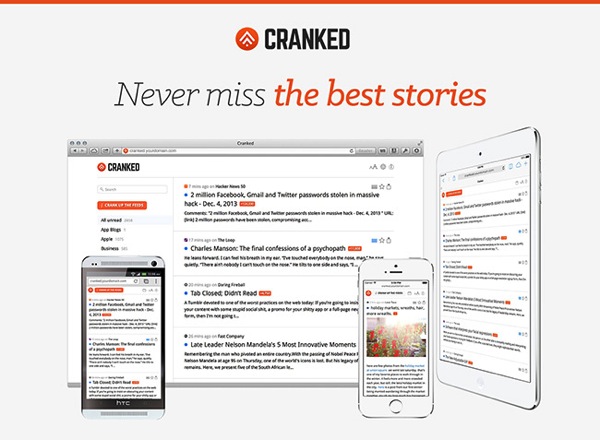
I was recently busy working on this new app called Cranked. It’s a self hosted RSS reader.
Before Cranked which I have been actively using for a month now, I was a Fever user. I’m a fan of Shaun Inman‘s work. I love using Fever. During the imminent shutdown of Google Reader, everyone flocked to all sorts of other hosted RSS reader applications like Feedly, Feedbin, Newsblur etc, I stuck with Fever.
I love Fever’s simplicity, but as time goes by, I find myself needing more. There were a couple of features I needed that I don’t think Shaun will be adding anytime soon, or even at all. Shaun’s a busy man with lots of other ongoing projects. That’s fair and I completely understand.
So I decided to build my own RSS reader that has everything I need.
Mobilize truncated articles
I want to be able to ‘mobilize’ truncated articles via Readability. A lot of websites truncate articles in their RSS feeds forcing you to read the full article by visiting their website. This is such that they can garner as much page views as possible for the benefit of their advertisers. That’s totally understandable. But when I’m using an RSS reader to do my reading, I want to stay in it without getting yanked out of the app after every other article. Mobilizing articles is a norm on native mobile applications like Tweetbot and Reeder, but rarely available on web applications. So I want to make this possible on Cranked.
Font preferences
Another aspect that I find annoying are font sizes. Every RSS reading application has predefined fonts and sizes you’ll be stuck reading with whether you like it or not. This ruins the reading experience for some people. Maybe I’m getting older, I like body font sizes to be bigger so I can read more comfortably. Of course this will not be the same for everyone, so I made font adjustment possible in Cranked.
Content discovery and curation
As much as I respect Shaun Inman and Fever’s ‘Hot’ feature, I just don’t find it useful, at least for me. Using the most highly regurgitated links as a metric for determining hot stories only leaves many great articles leaking through the crack. A lesser known author or blog may have written a great article worth reading but it may not be highly echo’d by well known media outlets. That’s where you will miss out on great content. Just look at highly voted news on Hacker News for example, most trending items aren’t regurgitated by popular websites, but they are on the front page of Hacker News. That is why people use Hacker News, for content discovery, for discovering the latest and greatest.
Every single vote on Hacker News count as a vote by people like you and me. The higher the vote, the more an article is worth reading.
How do I apply the same concept to an RSS reader to make content discovery more useful and accurate?
Social media sharing metrics.
People share articles from all over the world and these metrics can’t be gamed (or at least easily). You can’t force 10,000 people to share or like an article, even if you can, it’s extremely challenging or nearly impossible. When someone share or like an article, it’s usually because he or she is motivated to do that. Motivated by the usefulness or ‘share worthiness’ of that article. That is usually when an article is shared. And when 10,000 people do that, something about that article must have made people share it so wildly.
And when an article is shared or liked by someone, it counts as a vote that this article is worth reading. You might in turn find it interesting too, especially if you’ve subscribed to the site’s RSS feed in the first place.
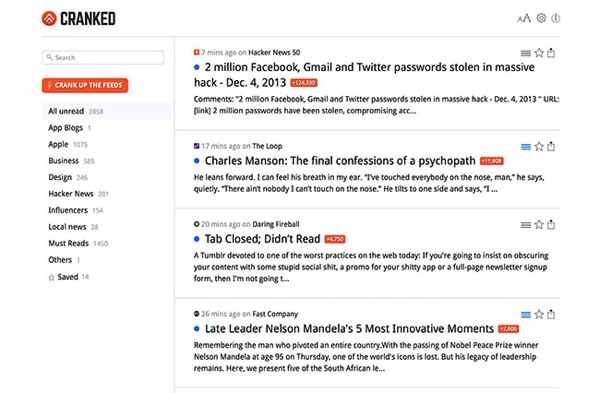
So, I built content discovery using social media metrics into Cranked by means of a toggle button called ‘Crank up the feeds’. Cranked is a regular RSS reader until you hit this button. All articles, no matter which folder, feed, search term you’re currently in will be sorted by the most liked and shared articles on Facebook and Twitter.
If you want to read the best stories in your ‘Design’ folder, you can. Best articles for the search term ‘iPad Air’? There you have it. Just keep the ‘Crank up the feeds’ toggle on. If you decide you want to see the latest news, toggle the ‘Crank up the feeds’ button off and you’ll see the latest news first just like any other RSS reader.
It’s a simple idea but it’ll transform your reading experience. There is nothing to learn and nothing to configure. Just a simple toggle button.
That’s what Cranked is. I did not make Cranked just to compete with Fever, I made Cranked because I want a perfect RSS reader for myself. Hope you’ll find it useful too.
You’ve probably heard it many times before – everyone’s different.
Have you ever wondered why you are good with faces / places but not names or the other way around? Or neither?
This can all be summed up in one concept – learning styles.
I think this should be covered early in school or taught to a child by parents. So that a kid can understand the core of who they really are and later on discover more easily what they are cut out to do. Teachers especially should all know how this works so they can adapt their teaching methods to suit each student.
There are three types of learning styles. You are stronger in either one of which, but not all:
Visual
VIsuals learn by seeing. They remember best by seeing more than any other way. This is why they’re good at remembering faces, places and read lots of books. There is no doubt they’re good in school as what’s drawn on the chalkboard can easily be absorbed. They don’t struggle that much when reading and memorizing, in fact, they’re good at it. They prefer email over the phone.
Auditory
Derived from the word ‘audio’, auditories remembers by listening. Tell them and they will remember. They’re usually good with names. Introduce a bunch of people in a social setting and the names will stick. You rarely need to repeat when giving them verbal instructions. They also do well in school as they can absorb lectures like a sponge. They’re good at telling stories and are usually good talkers. They prefer using the phone than email. They speak in good rhythms, you’ll feel engaged when hearing them speak.
Kinesthetic
Kinesthetics learn by doing. Give them a hands on demo and they will understand faster than telling them about it. They are practical and like to get their hands dirty. They prefer to fiddle with something until it works rather than reading an instruction manual. They don’t usually do well in school as lectures puts them to sleep. But they delight in dabbling with things and the more they do so, the more they become masters of it.
Why are these important?
Knowing which kind of learner you are prevents you from wasting time on the wrong path. Certain career paths requires certain attributes. An auditory outdoor sales person will likely outdo a kinesthetic one for instance.
Knowing your learning style, you will no long berate yourself for not being the person you aren’t cut out to be. You will no longer wonder why you struggle with certain things.
Can’t remember the directions to the place you’ve been yesterday? That’s because you’re not a ‘visual’. Struggling to remember the sequence of the verbal instruction you’ve just been given? That’s because you’re not ‘auditory’. Not good with being hands on? That’s because you’re not that ‘kinesthetic’.
Know your learning style and use it to realize your true potential.
This, cannot be more true. After creating a few products of my own for the past few years, I learnt that if something does not gain popularity, it probably never will.
Conventional wisdom tells you not to give up, be persistent, persevere and keep trying. Sometimes all you need to do is to try something else instead. Once you have a hit, then go ahead and be persistent, persevere and improve.
Iterate on the hit, not the failure.
Long article written in 2004 by Paul Graham. Worth every minute reading. It's like discovering a wealth of hidden knowledge and wisdom.
Wealth is the fundamental thing. Wealth is stuff we want: food, clothes, houses, cars, gadgets, travel to interesting places, and so on. You can have wealth without having money. If you had a magic machine that could on command make you a car or cook you dinner or do your laundry, or do anything else you wanted, you wouldn't need money. Whereas if you were in the middle of Antarctica, where there is nothing to buy, it wouldn't matter how much money you had.
The people most likely to grasp that wealth can be created are the ones who are good at making things, the craftsmen. Their hand-made objects become store-bought ones. But with the rise of industrialization there are fewer and fewer craftsmen. One of the biggest remaining groups is computer programmers. A programmer can sit down in front of a computer and create wealth. A good piece of software is, in itself, a valuable thing. There is no manufacturing to confuse the issue. Those characters you type are a complete, finished product. If someone sat down and wrote a web browser that didn't suck (a fine idea, by the way), the world would be that much richer.
To get rich you need to get yourself in a situation with two things, measurement and leverage. If you're in a job that feels safe, you are not going to get rich, because if there is no danger there is almost certainly no leverage.
+Permalink
I had an interesting discussion with one of Sendy‘s customer recently. Like many others, he questioned why I would offer Sendy at a one off fee of $59 when there are opportunities to tie a recurring fee to it. Sendy brings so much value to businesses and individuals who wants to send newsletters without having to spend exhorbitantly and yet I allow users to buy it at a one off fee? Isn’t that leaving money on the table?
Allow me to be direct: you do charge too low. ;-) No insinuation. Everyone thinks so.
Had I thought like everyone else, there would be no Sendy. We wouldn’t have been able to discontinue our web design business that has been wearing me out.
Sendy started in July 2012. Revenue did not grow steadily month after month, it grew exponentially.
When I launched Sendy, it immediately hit the front page of Hacker News just before I turned in. I made my first sale, then another. It did not stop.
I conducted a survey on my customer base asking them why they bought Sendy, the top answers are; it’s self hosted, one off fee and cheap. Now, why would I start introducing a monthly fee to bring Sendy down?
Hundreds of new startups launch everyday but most of them eventually fails. It can be due to many reasons. But the most important one is nothing more than being me too startups with almost the same feature set and pricing model. Why would anyone give these new startups a chance if there are already established ones? That is why it is difficult to get a SAAS product off its feet. Unless you have a crystal clear differentiator separating you from your competitors. This unique differentiation is the key to traction and success.
Sendy’s feature set does not match MailChimp’s at all, yet so many people switched to Sendy. Even from Aweber, Constant Contact, Campaign Monitor, Mad Mimi etc. The reason is clear, pay once and it’s yours, there is no need to pay again and again. Emails are sent with Amazon SES at a low ‘ten cents per thousand emails’, so deliverability is taken care of. At $59 one time fee, it’s cheap, so it’s easy to take a shot. For others that don’t find it cheap, they know it’s only a one off fee. Moreover, I do offer refunds if things don’t work out. When people start realizing how complex the application is and how valuable it is to their business, they begin to question why this isn’t $299 or $799 and why isn’t there a recurring fee tied to it? Why is it so cheap? Sendy’s pricing is wrong!
No matter how good a product is, it is useless if it does not catch anyone’s attention. Sendy successful caught people’s attention. Even the attention of Kevin Rose (Founder of Digg) and Christian Reber (CEO of 6Wunderkinder).
If Sendy’s pricing model starts with $19/month for instance, less people would give it attention and there will not be any traction. You may think $19/month is cheap, that is what I thought as well when I first started subernova.com and mockvault.com. The biggest mistake I made was being too over optimistic about adoption rates. I only learnt later that it is very difficult for people to make a commitment to shell out even just $5 a month – unless there is a damn good reason to. There is huge difference between paying “$5 a month” and “$5 only”.
So when you’re launching a new product, do not expect to succeed just by following blindly in the giant’s footsteps.
To add on, there are approximately 7,000,000,000 humans on earth at the time of writing. If your application caught people’s attention from the start, it will continue to do so, at least for a longer time than if it did not. The only question would be how to reach this vast amount of people who may be interested in your app.
The problem with most startups is that there is almost nothing for anyone to give a damn about. You can put it online for 5, 10, 20 years and you will never see it fly.
You can improve the odds by changing something, but without giving users a single compelling and selfish reason why they should consider giving your app their attention, your product is doomed to fail. At least that is what I have learnt. A very valuable lesson I will always use as a basis for anything.
What makes you great?
Your passion for learning and gaining more and more experience are what make you great. The nights you stayed up until 5am coding make you great. Your love of building things makes you great.
If I ever need to hire someone, this is exactly who I will hire in a heartbeat.
+Permalink
A very good read about how companies refuse to embrace the cloud for reasons like:
- Outages - You pay a lot more money hiring an IT team who's skills can't match the assembly of computer science talent at Google or Amazon
- You need to talk to someone on the phone during an outage - Why do you need to be pacified over the phone when engineers could use the same amount of time to fix the problem?
- Too insecure for your sensitive data - If you believe you can match the capabilities and rigor of Google’s Security Operations team, I wish you well.
+Permalink
Should you risk your career path with your hobby or settle on a corporate job? Good question, and even better answer (see the first answer on Quora).
There is no right answer. The problem is wasting time trying to make the "right" decision. You need to get your feet wet until you find what you want.
Do not, and I shall repeat for emphasis, do not defer this until a "better time". If you make a habit of that, you'll wake up one idle Monday and wonder how you let your whole life fly away.
+Permalink
Older posts




 @benhomie
 Email me
 Feed
Feed